
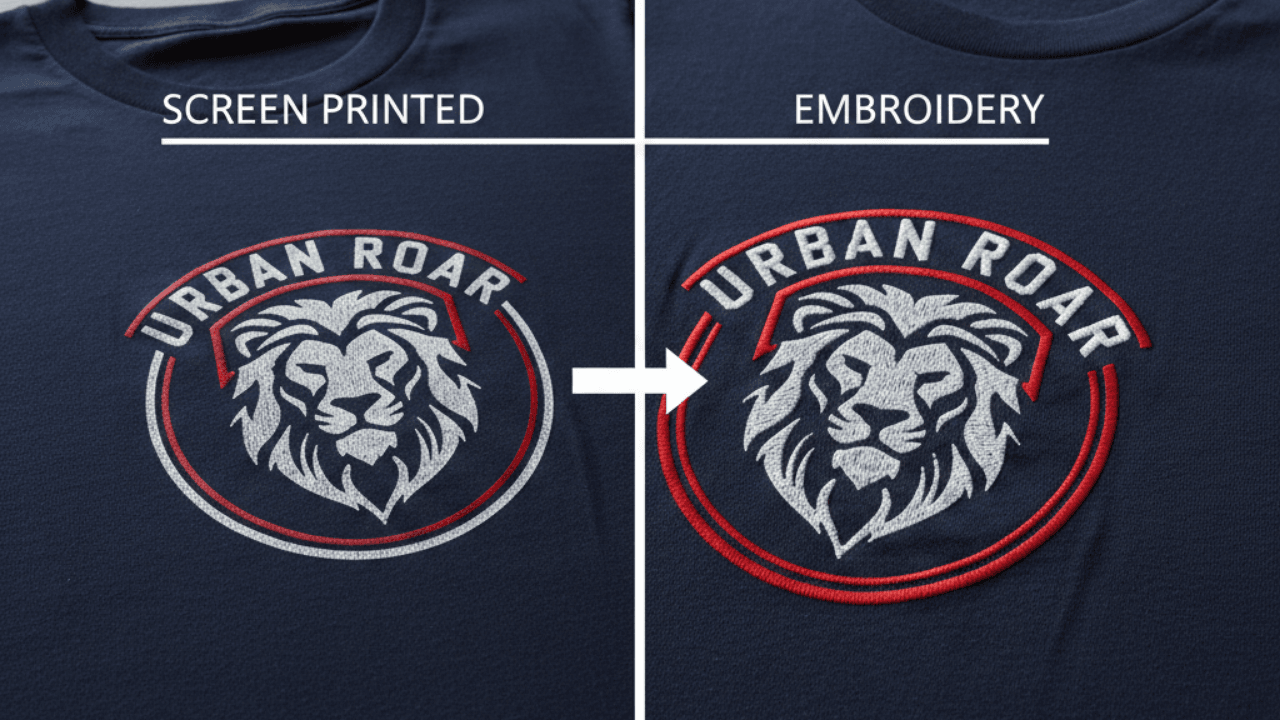
When it comes to branding t-shirts, most businesses face the same confusion:
Should we go with embroidery or printing?
At first glance, both seem to serve the same purpose — adding a logo or design. But in reality, the choice between embroidery and printing can affect how premium your brand looks, how long the garment lasts, how comfortable it feels, and how much you finally spend.
This guide breaks it down clearly so you can choose the right method based on use case, fabric, quantity, and brand positioning — not assumptions.
What Is Embroidery on T-Shirts?

Embroidery is a branding technique where the design or logo is stitched directly onto the fabric using threads. Instead of ink sitting on the surface, embroidery becomes part of the garment itself.
It is commonly used for:
- Corporate uniforms
- Office wear
- Premium merchandise
- Hospitality and institutional apparel
How embroidery works (in simple terms)
- The logo is digitised into a stitch pattern
- Machines stitch the design using coloured threads
- Stitch density and thread type determine finish and durability
Key characteristics of embroidery
- Slightly raised, textured finish
- Feels premium and professional
- Best suited for small to medium-sized logos
- Works well on thicker fabrics
What Is Printing on T-Shirts?

Printing involves applying ink or film onto the surface of the t-shirt to create designs. It allows far more flexibility in colours, size, and creativity.
Common printing methods include:
- Screen printing – best for large bulk orders
- DTF (Direct to Film) – good for detailed, multi-colour designs
- DTG (Direct to Garment) – ideal for short runs and photo-like prints
- Vinyl printing – mostly used for numbers or names
Key characteristics of printing
- Flat finish on the fabric
- Supports complex designs and gradients
- Suitable for large print areas
- Scales better for promotional and fashion use
Subscribe to factori.com on YouTube and see how every custom order comes to life — from fabric to finish!
Embroidery vs Printing: A Direct Comparison
1. Durability & Wash Life
- Embroidery: Extremely durable. Stitches rarely fade or crack, even after repeated washes.
- Printing: Durability depends on the method. Screen printing lasts well, while DTF and DTG may fade over time if not maintained properly.
Winner: Embroidery for long-term use
2. Look & Brand Perception
- Embroidery: Looks premium, formal, and professional.
- Printing: Looks expressive, creative, and modern.
Winner: Depends on brand personality
3. Design Flexibility
- Embroidery: Limited for very fine details, gradients, and large designs.
- Printing: Excellent for complex artwork, photos, and bold visuals.
Winner: Printing
4. Fabric Compatibility
- Embroidery: Best on thicker fabrics like polo t-shirts, heavy cotton, and blends.
- Printing: Works on almost all fabrics, including lightweight cotton and polyester.
Winner: Printing
5. Comfort & Breathability
- Embroidery: Stitch area can feel slightly heavier on thin t-shirts.
- Printing: Feels lighter, especially for large designs.
Winner: Printing for comfort on lightweight tees
6. Scalability for Bulk Orders
- Embroidery: Setup cost makes it more expensive at lower quantities.
- Printing: Becomes cost-effective at higher volumes, especially screen printing.
Winner: Printing for bulk campaigns
Cost Comparison: Why Prices Differ
Instead of exact numbers, it’s important to understand what drives the cost.
Embroidery cost depends on:
- Number of stitches
- Logo size
- Thread colours
- Fabric thickness
Smaller quantities often feel expensive because digitisation and setup costs are fixed.
Printing cost depends on:
- Print method
- Number of colours
- Print size
- Quantity
Printing becomes cheaper as quantity increases, especially with screen printing.
Latest article: How Brands Can Turn T-Shirts into Long-Term Marketing Assets
When Embroidery Is the Better Choice
Embroidery works best when:
- You want a premium, professional look
- The logo is small and minimal
- Apparel is used daily or long-term
- You are branding corporate or institutional wear
Quick checklist
- Logo size: Small to medium
- Fabric: Thick cotton or blends
- Usage: Long-term
- Audience: Internal teams or professionals
When Printing Is the Better Choice
Printing is ideal when:
- Designs are large, colourful, or detailed
- Apparel is used for events, promotions, or resale
- You need cost efficiency at scale
- Fashion appeal matters more than formality
Quick checklist
- Design complexity: High
- Quantity: Medium to large
- Budget: Controlled
- Usage: Short to mid-term

Using Embroidery and Printing Together (Smart Brands Do This)
Many brands don’t choose one — they use both.
Common combinations:
- Embroidered chest logo + printed back design
- Sleeve embroidery + front print
- Minimal embroidery for identity + print for storytelling
This hybrid approach balances premium feel and creative freedom.
Common Mistakes Brands Make
- Choosing only based on cost
- Using embroidery on thin t-shirts
- Printing fine logos that should be embroidered
- Ignoring fabric compatibility
- Not sampling before bulk production
These mistakes often lead to poor finish and wasted inventory.
How to Choose the Right Branding Method for Your Brand
Ask yourself:
- Is this apparel for daily use or promotion?
- Do I want premium or expressive branding?
- What fabric am I using?
- Is the logo small or design-heavy?
- How long should the branding last?
Your answers will usually point clearly to embroidery, printing, or a mix of both.
How factori.com Helps Brands Make the Right Choice
Choosing between embroidery and printing shouldn’t be guesswork.
factori.com helps brands by:
- Recommending the right branding method based on use case
- Offering sampling before bulk orders
- Executing at factory level for consistent quality
- Managing both embroidery and printing under one ecosystem
This ensures branding decisions are practical, scalable, and cost-efficient.
FAQs
Embroidery is better for logos that need a premium and professional look, especially on corporate or uniform t-shirts. Printing is better for creative, colourful, or large designs. The right choice depends on usage, fabric type, and design size.
Embroidery usually lasts longer than printing because the design is stitched into the fabric. Printed designs can fade or crack over time depending on the printing method and wash care.
Embroidery is often more expensive for small quantities because of setup and stitch costs. Printing becomes more cost-effective for larger quantities and complex designs, especially in bulk orders.
Yes, embroidery can be done on cotton t-shirts, but it works best on thicker cotton fabrics. Very thin cotton t-shirts may feel heavy or stiff after embroidery.
Printing is generally better for bulk t-shirt orders because it scales efficiently and reduces per-unit cost. Embroidery is better suited for smaller logos or premium bulk uniforms.
Leave a Reply