
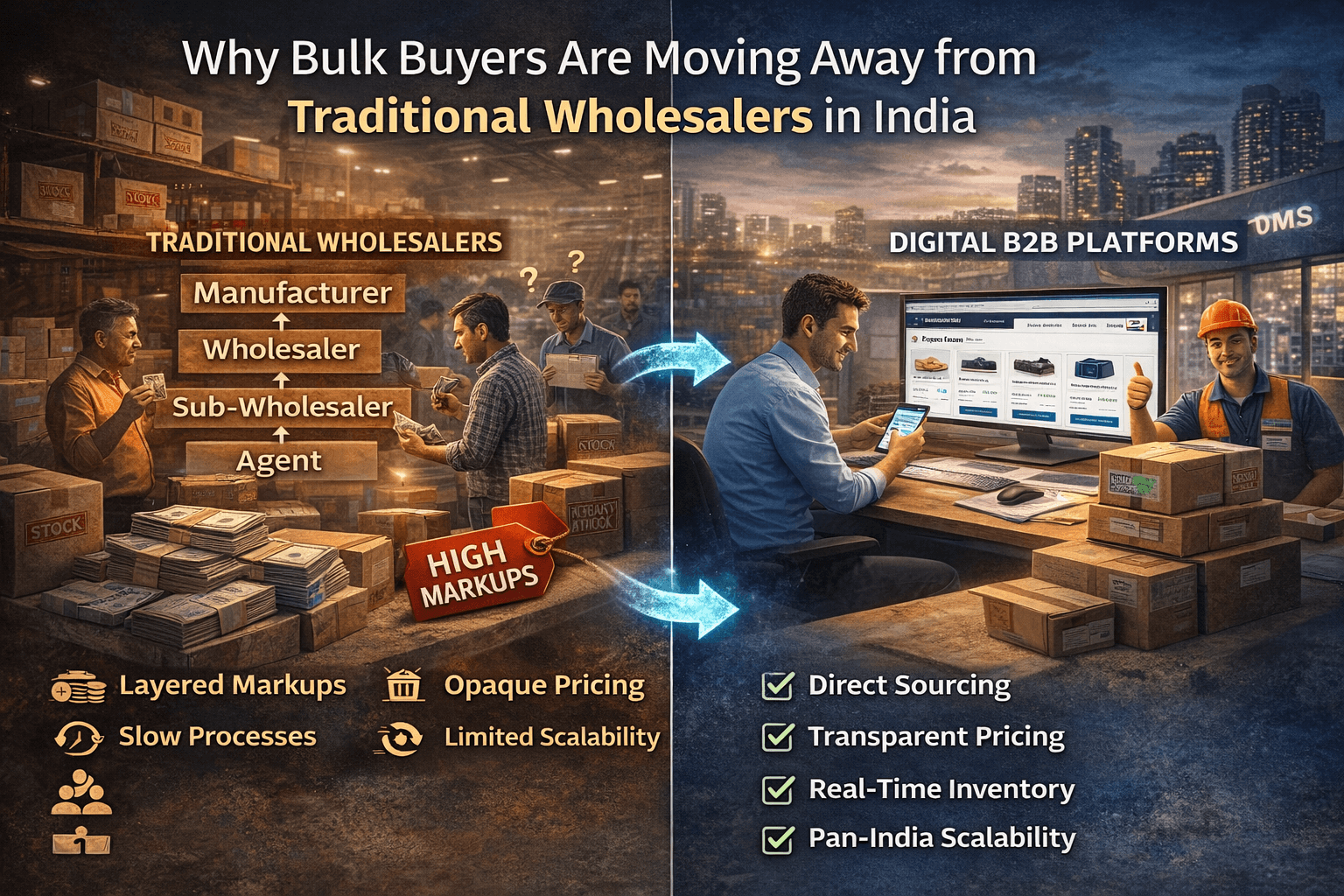
India’s bulk buying ecosystem is changing faster than ever. For decades, wholesalers were the backbone of B2B trade, connecting manufacturers with retailers, institutions, and enterprises. However, a growing number of bulk buyers—ranging from MSMEs and distributors to corporate procurement teams—are now actively moving away from traditional wholesalers.
This shift is not accidental. It is driven by rising cost pressures, demand for speed, and the availability of digital B2B platforms that offer greater transparency and control. In this article, we explore why bulk buyers are moving away from traditional wholesalers in India and what is replacing them.
The Limitations of Traditional Wholesalers in Modern B2B Trade
Traditional wholesale models were built for an era of limited information and physical trade networks. While they served their purpose, today’s buyers face several challenges when relying on wholesalers:
- Lack of price transparency, with margins layered across multiple intermediaries
- Unclear inventory visibility, leading to stockouts or over-ordering
- Long procurement cycles due to manual coordination and follow-ups
- Limited customization options, especially for branded or private-label products
- Dependency on regional availability, restricting scalability
As competition intensifies, these inefficiencies directly impact profitability and speed to market.
Latest article: Birla Opus Partners with factori.com for Employee Merchandise
Bulk Buyers Now Prioritize Speed, Control, and Visibility
Modern bulk buyers operate in a highly competitive environment where timing and cost efficiency matter. Whether it’s a retailer stocking seasonal products or a corporate buyer sourcing employee merchandise, delays can lead to lost revenue.
Digital-first buyers now expect:
- Real-time stock availability
- Faster dispatch and shorter lead times
- Direct access to manufacturers
- Predictable pricing and quality standards
Traditional wholesalers often struggle to meet these expectations at scale.
Rise of Digital B2B Trading Platforms in India
One of the biggest reasons bulk buyers are moving away from wholesalers is the emergence of digital B2B trading platforms. These platforms eliminate unnecessary intermediaries and connect buyers directly with verified manufacturers and ready-to-ship inventory.
Platforms like factori.com enable businesses to source products through transparent, technology-driven systems that provide:
- Live inventory visibility
- Verified supplier networks
- Flexible order quantities
- Faster procurement decisions
This shift allows buyers to operate with greater confidence and lower risk.
Cost Efficiency Is Driving the Change
In traditional wholesale setups, costs accumulate across distribution layers—manufacturer, wholesaler, sub-wholesaler, and agent. Bulk buyers end up paying for inefficiencies they cannot control.
By sourcing through digital manufacturing and trading platforms, buyers benefit from:
- Reduced intermediary margins
- Competitive factory-level pricing
- Better negotiation power through data visibility
- Optimized working capital usage
For bulk buyers operating on thin margins, these savings are significant.
Subscribe to factori.com on YouTube and see how every custom order comes to life — from fabric to finish!
Demand for Customization and Private Labeling
Another major limitation of wholesalers is their inability to support customization at scale. Bulk buyers today increasingly demand:
- Custom branding
- Private-label manufacturing
- Product modifications based on use cases
Traditional wholesalers typically deal in standardized stock, making customization slow or impossible. Platforms like factori.com bridge this gap by combining ready-to-ship products with contract manufacturin, giving buyers flexibility without operational complexity.
Improved Risk Management and Reliability
Bulk procurement involves financial and operational risk. Delays, inconsistent quality, and unreliable suppliers can disrupt entire supply chains.
Digital B2B platforms reduce this risk by offering:
- Verified manufacturer onboarding
- Quality-controlled sourcing
- Clear timelines and order tracking
- Centralized communication
This reliability is a key reason enterprises and MSMEs are rethinking wholesale dependence.
Traditional Wholesalers vs Digital B2B Platforms
| Aspect | Traditional Wholesalers | Digital B2B Platforms |
| Pricing Transparency | Low | High |
| Inventory Visibility | Limited | Real-time |
| Lead Time | Long | Short |
| Customization | Minimal | Flexible |
| Scalability | Regional | Pan-India & Global |
The Future of Bulk Buying in India
The future of bulk procurement in India is platform-led, data-driven, and manufacturer-connected. Wholesalers will continue to exist, but their role is evolving. Bulk buyers now prefer systems that offer speed, transparency, and control.
Platforms like factori.com represent this new era—where sourcing, manufacturing, and fulfillment are integrated into one digital ecosystem.
Conclusion
Bulk buyers are not abandoning wholesalers without reason. They are responding to market realities that demand faster decisions, better pricing, and operational efficiency. Digital B2B trading platforms are filling the gaps that traditional models can no longer address.
For businesses looking to scale sustainably, the shift away from wholesalers is not just logical—it is inevitable.
Explore smarter bulk sourcing and digital trade solutions at factori.com and experience the future of B2B procurement in India.
FAQs
Bulk buyers seek better pricing transparency, faster lead times, and direct access to manufacturers—areas where traditional wholesalers fall short.
Digital B2B trading platforms that connect buyers directly with manufacturers and ready-to-ship inventory are increasingly replacing wholesalers.
Yes. Verified supplier networks, quality checks, and real-time tracking make digital platforms more reliable than manual wholesale systems.
They eliminate multiple intermediaries, reduce hidden margins, and offer factory-level pricing.
Absolutely. Both MSMEs and enterprises benefit from faster sourcing, scalability, and improved control over procurement.
Leave a Reply