
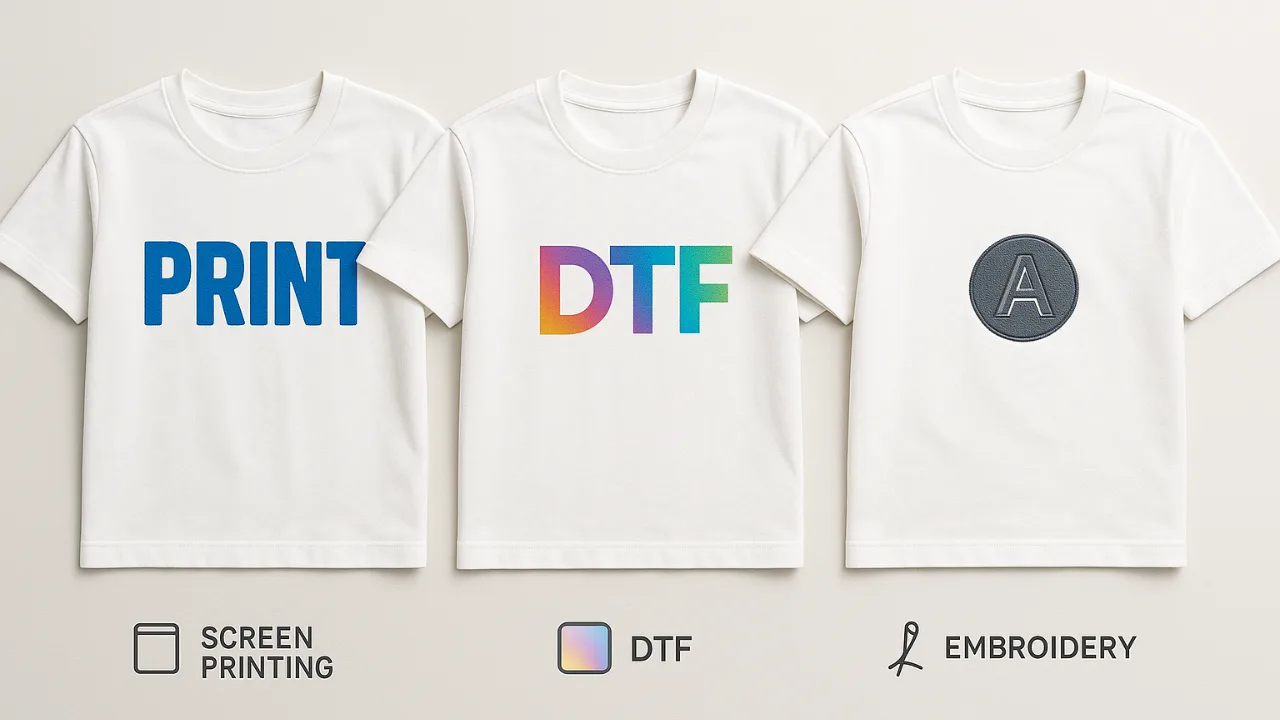
If you’re ordering custom T-shirts, corporate merchandise, uniforms, or event apparel, choosing the right printing technique is one of the most important decisions you’ll make. The fabric, colour, stitching and fit all matter — but the branding finish is what people notice first. And in 2025, with more companies investing in bulk T-shirt manufacturing, employee kits and corporate events, printing quality has become a brand perception tool, not just a technical detail.
But most founders, HR teams and marketing managers still find themselves asking the same question:
“What’s the difference between screen printing, DTF and embroidery — and which one should I choose?”
This guide breaks it down in simple, practical language. No jargon, no confusing explanations — just clear insights that help you make the right decision depending on your design, quantity, budget and use case.
Whether you’re planning a uniform rollout, marathon T-shirts, branded polos or premium merchandise, this article will walk you through everything you need to know.

Why Your Printing Technique Matters More Than Ever
In the last two years, we’ve seen a major shift in how companies approach apparel and merchandise. The trend has moved from “just print something” to “build a brand experience.” That’s why printing technique matters — because the finish you choose must match the message you want your brand to convey.
In bulk T-shirt manufacturing and corporate merchandise, printing affects:
- How premium the final product looks
- How long the branding lasts
- How comfortable the apparel feels
- How sharp and accurate your logo appears
- How repeatable it is across hundreds or thousands of pieces
If your printing cracks after a few washes, feels rubbery, or loses colour easily, customers assume the product is cheap — even when the fabric quality is excellent.
That’s why understanding printing is just as important as knowing your GSM, fabric type or stitching pattern.
A Quick Introduction to the Big 3 Printing Techniques
Before we go into the detailed comparisons, here’s a simple explanation of how each technique works:
Screen Printing
Ink is pushed through a mesh screen onto fabric. Each colour gets its own screen. It’s the industry standard for bulk orders because it’s durable, cost-efficient and vibrant.
DTF (Direct-to-Film) Printing
A digital printer prints your artwork onto a film, which is then heat-pressed onto the fabric. It handles any colour, gradient or complex design instantly.
Embroidery
Your logo is stitched with threads using a computerized embroidery machine. It gives a premium, professional identity — perfect for polos, uniforms and hoodies.
Now let’s break down each technique in depth.
Follow @factori.com_official to watch how we create custom T-shirts, uniforms, and merch — one order at a time!
Screen Printing (The Industry Workhorse)

How It Works
Screen printing involves creating a mesh screen for each colour in your design. Ink is pushed through the screen onto the fabric, creating a long-lasting and vibrant print. It’s widely used in bulk T-shirt manufacturing because once the screens are ready, printing becomes fast and consistent.
Advantages of Screen Printing
- Ultra-durable: Can withstand 40–60 washes easily.
- Cost-effective for bulk quantities: Perfect for 200–5000+ pieces.
- Vibrant colours: Strong opacity, sharp edges, excellent saturation.
- Ideal for cotton T-shirts: Works beautifully on 100% cotton, combed cotton and ring-spun fabrics.
Limitations
- Not ideal for small quantities due to setup costs.
- Multicolour designs become expensive.
- Not suitable for high-detail or photorealistic artwork.
- Requires flat logos or text-based designs for best results.
Best Use Cases
- Marathon/event T-shirts
- Corporate T-shirts for employees
- Promotional giveaways
- College fest merchandise
- Bulk custom T-shirt manufacturing
If your design is simple and your quantity is high, screen printing almost always gives the best value.
DTF Printing (The New-Age Flexible Option)

How It Works
DTF uses high-resolution digital printers to print your design onto a film. This film is then heat-pressed onto the fabric. No screens, no expensive setup, no colour restrictions.
It’s become extremely popular in 2024–2025 because customers want faster sampling, unlimited colours and freedom to print complex logos.
Advantages of DTF
- Print any design: Gradients, shadows, photos, multicolours — all possible.
- Great for small and medium quantities: No setup cost = cost-efficient.
- Works on all fabrics: Cotton, polyester, blends, hoodies — all compatible.
- Fast turnaround: Perfect for tight deadlines and prototypes.
Limitations
- Slight rubbery texture compared to screen printing.
- Very complex logos may feel heavier on thin fabrics.
- Durability is good, but not exceptional — around 30–50 washes
- Not ideal for high-performance sportswear.
Best Use Cases
- Detailed employee merchandise
- Small and medium quantity corporate gifting
- Complex logos and brand artwork
- On-demand merchandise
- Sampling before bulk orders
DTF is the “design freedom” printing technique — great when creativity matters more than quantity.
Embroidery (The Premium Identity Choice)

How It Works
Your logo is converted into a stitch file (digitization). Then, computerized embroidery machines use threads to recreate your branding on apparel with a premium, 3D finish.
Advantages
- Premium, professional look (perfect for corporates).
- Extremely durable: Lasts for years, not months.
- Works beautifully on thick fabrics: Polos, hoodies, jackets.
- Adds perceived value: Makes merchandise feel high-quality.
Limitations
- Not suitable for thin fabrics like single-jersey T-shirts.
- Large designs become expensive.
- High stitch-density designs may feel heavy.
Best Use Cases
- Corporate uniforms
- Hospitality and service teams
- Premium brand polos
- Hoodies and sweatshirts
- Employee onboarding kits
Embroidery is the best choice when brand perception is more important than design complexity.
Subscribe to factori.com on YouTube and see how every custom order comes to life — from fabric to finish!
Side-By-Side Comparison Table
| Feature | Screen Printing | DTF | Embroidery |
| Durability | ⭐⭐⭐⭐ | ⭐⭐⭐ | ⭐⭐⭐⭐⭐ |
| Complex Artwork | Limited | Excellent | Limited |
| Bulk Orders | Best | Good | Good |
| Feel on Fabric | Soft | Slightly rubbery | Textured |
| Small Quantities | Not ideal | Best | Good |
| Premium Look | Medium | Medium | High |
| Best For | Corporate T-shirts, events | Complex logos, samples | Polos, uniforms |
How to Choose the Best Printing Technique (The 2025 Decision Guide)
A simple rule of thumb:
- Choose Screen Printing if:
- Your design is simple
- Quantity is above 100
- Durability is important
- You want the best value for money
- Choose DTF if:
- Your design is detailed or multicolour
- You need small or medium quantities
- You want fast sampling
- You need flexibility across different fabrics
- Choose Embroidery if:
- You’re printing on polos, hoodies or uniforms
- You want a premium corporate look
- Durability is the top priority
This framework alone helps companies avoid 90% of printing mistakes.
Common Mistakes Brands Make (And How to Avoid Them)
1. Choosing DTF for event T-shirts
For marathon/event tees, screen printing is far more durable and sweat-friendly.
2. Using embroidery on thin T-shirts
This causes puckering and looks unprofessional.
3. Selecting screen printing for very detailed logos
Gradients and shadows don’t show up well.
4. Prioritizing cost instead of purpose
The cheapest option often becomes the most expensive later.
5. Not checking wash tests
Always ask your vendor for wash test results — especially for DTF.
Real Examples From Manufacturing Projects
Here are typical scenarios where these decisions truly matter:
- A marathon with 8,000 participants: Screen printing worked flawlessly because it was durable and sweat resistant.
- A corporate polo order for a tech company: Embroidery gave the premium finish they wanted.
- A startup sending merch to influencers: DTF handled multicolour designs beautifully.
- A uniform project for a logistics team: Embroidery ensured long-term durability despite rough usage.
These decisions directly affect brand perception, lifespan and comfort — which is why choosing the right printing technique matters more than most companies realise.
Conclusion
There’s no “one best printing technique.”
There’s only the best printing technique for your purpose.
If you want durability and cost efficiency → go for screen printing.
If your design is complex or quantity is small → choose DTF.
If you want a premium corporate identity → choose embroidery.
If you still feel unsure, the safest option is to speak with your manufacturer — they will assess your design, fabric, use case and budget before recommending the right solution.
Need Help Choosing the Right Technique?
If you’re planning corporate merchandise, bulk T-shirt manufacturing, uniforms or event apparel, the factori.com team can help you make the right choice — with sampling, recommendations and fast turnaround.
FAQs
The best printing method depends on your design and quantity.
Screen printing is ideal for simple designs and large quantities (100+).
DTF works best for detailed, multicolour artwork and smaller quantities.
Embroidery is the top choice for polos, hoodies and premium uniforms.
There is no one “best” method — the right technique depends on purpose.
Yes. Screen printing is usually the better option for bulk orders because it is more cost-efficient, more durable and delivers softer prints. DTF is great for smaller batches or complex designs, but screen printing is the industry standard for events, marathons, corporate tees and large production runs.
Choose DTF when your design has gradients, shadows, or multiple colours. It’s also the best option for small and medium quantities, quick samples, or when you need to print the same artwork on different fabrics like cotton, polyester or blends. It gives excellent detail without the high setup cost of screen printing.
Embroidery is not recommended for thin single-jersey T-shirts because it causes puckering and feels heavy. Embroidery works best on polos, hoodies, jackets and uniforms, where the fabric thickness supports the stitched logo and enhances the premium look.
Embroidery lasts the longest because the design is stitched directly into the fabric.
After that:
Screen printing offers excellent durability (40–60+ washes).
DTF has good durability (30–50 washes) but may feel heavier on thin fabrics.
For maximum lifespan, embroidery is the most durable technique.
Leave a Reply